
Article Summary: V-bank filters are high-efficiency air filtration devices that arrange multiple pleated filter media panels in a V-shaped configuration. This maximises the filtration surface area while minimising the required space and airflow resistance. According to the ASHRAE Handbook: HVAC Systems and Equipment, and guidance from the U.S. Environmental Protection Agency (EPA) on indoor air quality, effective air filtration depends on particle removal efficiency, system airflow, pressure drop, and application-specific requirements. V-bank filters are widely used in commercial HVAC systems, industrial facilities, laboratories, hospitals, and cleanroom environments, where balancing high airflow capacity, reliable filtration, and energy efficiency is essential.
What Are V-Bank Filters?
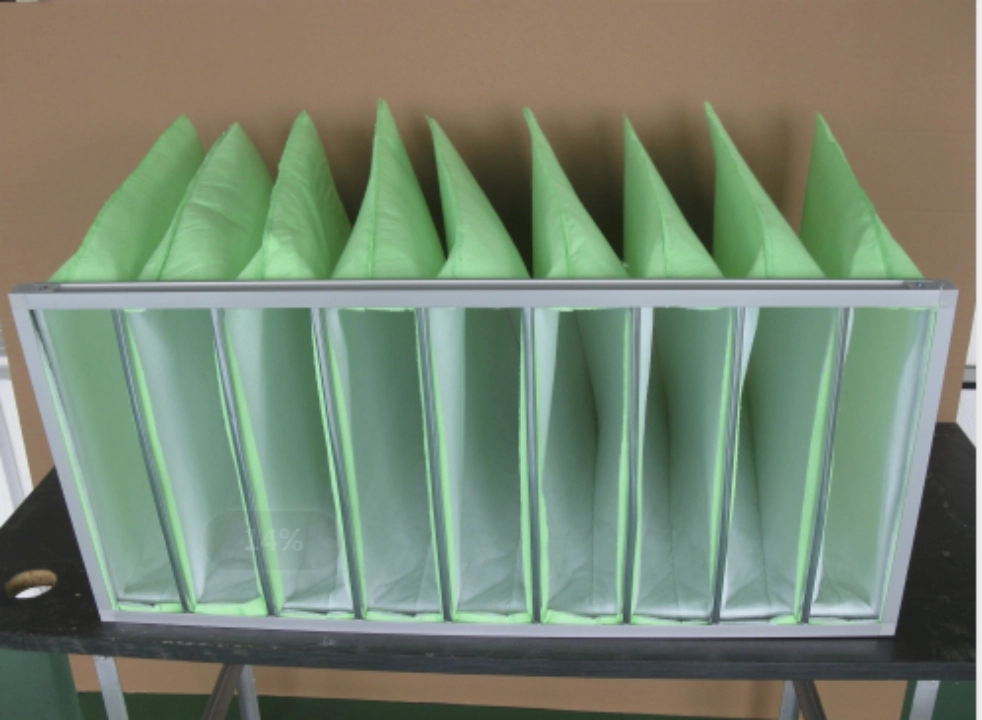
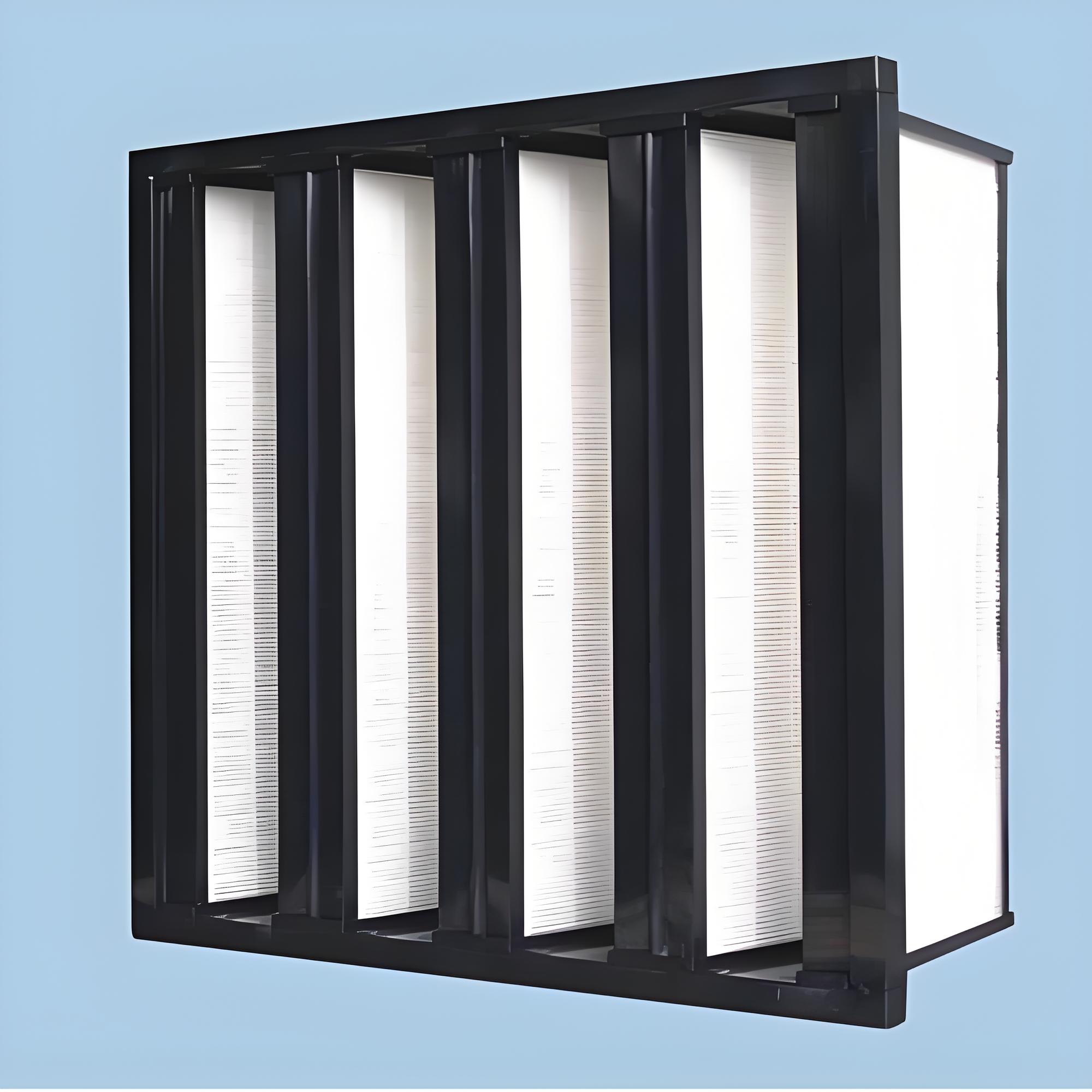
V-bank filters, also known as V-bank air filters, V-shaped compact filters, or V-cell filters, are high-efficiency air filtration components designed to remove airborne particles from ventilation and air conditioning systems. They are characterised by the arrangement of multiple filter media panels into a series of V-shaped sections within a rigid structural frame. This geometry creates a substantially larger effective filtration area than a conventional flat filter of comparable face dimensions.
In industrial and commercial HVAC applications, V-bank filters are commonly installed in air handling units (AHUs) to capture fine particulate matter, including dust, pollen, and other airborne contaminants. Depending on the filter media and its efficiency classification, V-bank filters can be used as final filters in general ventilation systems, or as pre-filters to protect downstream HEPA filtration equipment in critical environments.
The fundamental engineering principle is straightforward: more effective filter media area within a limited installation footprint helps to reduce air resistance while maintaining the required particle removal efficiency. However, actual performance depends on the characteristics of the filter media, airflow velocity, filter configuration, sealing quality, and operating conditions, rather than geometry alone.
How Do V-Bank Filters Work?
V-bank filters operate using the same fundamental particle capture mechanisms as other fibrous air filters. As contaminated air passes through the pleated filtration media, airborne particles are captured by several physical processes, such as interception, inertial impaction, and diffusion. The contribution of each process varies depending on the size of the particles, the velocity of the airflow, and the structure of the fibres.
The V-shaped arrangement changes the distribution of the filtration media within the filter frame. Rather than concentrating all the media into a single flat surface, the design uses multiple angled panels to accommodate a larger filtration area. This helps to distribute the airflow across the media, which can reduce the effective media face velocity under the right operating conditions.
Key operating principles
- Airflow distribution: Incoming air enters the filter face and is distributed across multiple angled media panels.
- Particle capture: Fibrous media retain airborne particles as air passes through the filter structure.
- Pressure management: The expanded media area can reduce resistance compared with some conventional filters operating at equivalent airflow and filtration requirements.
- Filtered air delivery: Cleaned air exits the downstream side and continues through the HVAC system toward the occupied or controlled environment.
It is important to distinguish filtration efficiency from pressure drop. A filter that captures more particles may also create greater airflow resistance if its media and geometry are not properly designed. Therefore, engineers should evaluate both characteristics when selecting V bank filters for a specific installation.
What Are the Main Components of V Bank Filters?
The performance and durability of a V bank filter depend on the integration of several components. Each element contributes to filtration effectiveness, structural integrity, and compatibility with the air handling system.
- Фильтрующий материал
The filter media is the primary particle-capturing component. Common materials include microfine fiberglass and synthetic fibers, with the selection depending on the desired efficiency, humidity resistance, operating environment, and maintenance requirements.
- V-shaped media packs
Multiple pleated media panels are arranged into V-shaped configurations. The number of V sections varies by design, with two-bank and four-bank configurations commonly available. More panels can provide additional media area, although the final performance depends on the complete filter design.
- Structural frame
The frame supports the media packs and maintains their geometry during transportation, installation, and operation. Common materials include galvanized steel, aluminum, and high-impact plastics. Frame selection should consider rigidity, corrosion resistance, weight, and compatibility with the filter housing.
- Sealing system
Gaskets, sealants, and perimeter bonding help prevent air from bypassing the filtration media. Even a high-efficiency filter can deliver inadequate system performance if contaminated air leaks around its edges.
- Protective and support components
Some designs incorporate protective grids, separators, or reinforcement structures to maintain pleat stability and prevent damage under changing airflow conditions.
What Are the Different Types of V Bank Filters?
V bank filters can be classified according to their media material, filtration efficiency, configuration, and intended application. Understanding these distinctions helps engineers and procurement teams identify a suitable product rather than relying on the general term “V bank filter.”
- Fiberglass V Bank Filters
Fiberglass V-bank filters use fine glass fibre media to capture airborne particles. They are often chosen for high-efficiency commercial and industrial filtration applications because, when engineered correctly, the glass fibres can provide strong particle retention and stable filtration characteristics.
These filters are commonly available with different efficiency ratings, including MERV 13, MERV 14, MERV 15 and MERV 16, depending on the manufacturer’s product range. The moisture resistance, operating temperature, and structural design of fiberglass filters should be reviewed before specifying them for demanding environments.
- Synthetic V Bank Filters
Synthetic V-bank filters use engineered polymer fibres to form the filtration medium. They are often used in applications that require moisture resistance, a lightweight construction, and compatibility with specific environmental conditions.
Synthetic media are particularly well-suited to facilities where humidity fluctuations or handling requirements influence filter selection. However, a synthetic construction does not automatically equate to a lower pressure drop or superior efficiency. Performance must be verified using standardised testing and product-specific technical data.
- High-Efficiency V Bank Filters
High-efficiency V-bank filters are designed to capture smaller airborne particles and support stricter indoor air quality requirements. Depending on their classification and construction, they can be used as final filters in commercial ventilation systems, or as upstream filtration stages for HEPA installations.
For critical applications, however, filter efficiency alone is insufficient. System designers should also consider leakage control, installation integrity, airflow uniformity and the required cleanliness level.
- Activated Carbon V Bank Filters
Activated carbon V-bank filters use adsorbent media to address gaseous contaminants, odours, and certain volatile organic compounds (VOCs). Unlike conventional particulate filters, they are primarily designed for controlling molecular contaminants rather than capturing particles.
They are used in facilities such as airports, laboratories, and chemical processing environments, as well as commercial buildings, where outdoor pollution or process emissions may affect indoor air quality. The appropriate adsorbent depends on the target contaminant, its concentration, humidity levels, and the required service life.
V Bank Filter Specifications and Technical Parameters
Selecting a V bank filter requires a detailed review of its technical specifications. Nominal dimensions alone cannot determine whether a filter will perform correctly in an HVAC system.
The following table summarizes commonly evaluated parameters. Actual values vary by manufacturer and model; the ranges shown are illustrative rather than universal industry requirements.
| Parameter | Typical Options or Considerations |
| Конфигурация фильтра | 2V, 3V, 4V or multiple V-shaped banks |
| Nominal depth | 12 in (305 mm); other depths available |
| Filter efficiency | MERV 11–16, depending on model |
| Фильтрующий материал | Fiberglass or synthetic |
| Frame material | Galvanized steel, aluminum, or plastic |
| Initial pressure drop | Model-specific; often approximately 80–150 Pa |
| Recommended final pressure drop | Manufacturer-defined operating limit |
| Operating temperature | Depends on media, frame, and adhesive |
| Installation method | Front-access, side-access, or compatible filter housing |
| Application | Commercial HVAC, industrial ventilation, laboratories, and cleanrooms |
Important: Pressure drop values, temperature limits, airflow ratings, and efficiency classifications must always be confirmed using the manufacturer’s current datasheet. Different test standards and product configurations may produce different results.
What Are the Advantages of V Bank Filters?
V-bank filters are widely adopted because their design can address several challenges associated with high-efficiency air filtration in modern ventilation systems.
- High Filtration Surface Area
The V-shaped configuration accommodates more filter media within a limited face area. This increased effective surface area can help distribute airflow and support high-volume filtration applications without requiring an excessively large filter installation footprint.
- Lower Airflow Resistance Potential
When designed for the required airflow and efficiency, V bank filters can achieve relatively low pressure drop compared with certain conventional high-efficiency filter designs. Lower resistance may reduce the energy required by HVAC fans, although actual savings depend on the complete system and operating conditions.
- High Airflow Capacity
V bank filters are suitable for air handling systems that require substantial airflow through compact filter sections. This makes them valuable in large commercial buildings, industrial plants, and facilities where ventilation capacity must be maintained within limited equipment space.
- Extended Service Life
The increased media area can support higher dust-holding capacity, allowing some V bank filters to operate longer before reaching their recommended replacement pressure drop. Service life is influenced by particulate concentration, operating hours, humidity, upstream filtration, and maintenance practices.
- Compact Installation
The multi-panel design allows high-efficiency filtration to be integrated into relatively shallow HVAC equipment. This can be particularly advantageous in retrofit projects where the existing AHU dimensions restrict the use of deeper or larger filter assemblies.
- Reduced Maintenance Burden
A filter with appropriate dust-holding capacity and operating resistance may require fewer replacements over its service life. Reduced changeout frequency can lower labor costs, disposal expenses, and interruptions to facility operations.
V Bank Filters vs. Traditional Bag Filters and HEPA Filters
V bank filters, bag filters, and HEPA filters are often discussed together in HVAC design, but they serve different purposes and are not necessarily interchangeable. Their suitability depends on the required filtration efficiency, available installation space, airflow rate, and system configuration.
| Характеристика | V Bank Filters | Bag Filters | HEPA Filters |
| Main design | Multiple V-shaped media panels | Extended pockets or bags | High-efficiency dense media |
| Media area | High within compact footprint | Large, extended pocket area | Depends on construction |
| Typical application | High-efficiency HVAC filtration | General and intermediate filtration | Critical particle control |
| Airflow capacity | Often high for compact designs | Depends on pocket geometry | Model- and application-specific |
| Pressure drop | Designed to balance efficiency and resistance | Varies with pocket depth and media | Can be substantial without optimized design |
| Installation space | Compact depth options available | Often requires pocket clearance | Depends on housing and filter depth |
| Common role | Final filtration or HEPA prefiltration | Prefilter or intermediate stage | Final filtration in critical environments |
Which filter is better?
- V bank filters: Appropriate when high airflow, compact dimensions, and elevated particle filtration efficiency must be balanced.
- Bag filters: Useful when the system can accommodate extended pockets and requires effective intermediate filtration or dust-loading capacity.
- HEPA filters: Necessary when the application requires very high particle removal efficiency under the applicable classification and testing standard.
The decision should be based on engineering requirements rather than assuming that one filter type is universally superior.
What Are the Applications of V Bank Filters?
V-bank filters are used in a wide range of industries where air quality, ventilation performance, and operational reliability are important.
They are used in commercial buildings and HVAC systems, such as in office buildings, shopping centres, hotels, and educational institutions, to improve indoor air quality and provide efficient filtration in central air handling systems. Their compact structure is particularly useful in systems with limited filter section depth.
- Hospitals and Healthcare Facilities
Healthcare ventilation systems may use high-efficiency V-bank filters in designated air handling applications. However, filter selection must follow applicable healthcare ventilation standards, including requirements governing specific room types, air changes, and filtration stages.
- Pharmaceutical and Biotechnology Manufacturing
Pharmaceutical production and biotechnology facilities require controlled environmental conditions to protect processes and products from airborne contamination. V bank filters may serve as intermediate or high-efficiency filtration stages upstream of terminal HEPA filters.
- Cleanrooms and Electronics Manufacturing
Cleanroom systems use carefully designed filtration stages to control airborne particles that may affect sensitive manufacturing processes. V bank filters can provide upstream filtration and help protect downstream high-efficiency equipment.
- Промышленное производство
Manufacturing facilities, automotive plants, and industrial processing environments use V bank filters to manage airborne particulate contamination and support ventilation requirements. The correct filter depends on the contaminant profile and the specific production process.
- Data Centers
Data centers use air filtration to control airborne dust and particulate matter that may accumulate on electronic equipment. V bank filters can be incorporated into cooling and ventilation systems where airflow capacity, equipment protection, and energy consumption must be managed together.
How to Select the Right V Bank Filter?
Choosing a suitable V bank filter requires a systematic evaluation of operating conditions rather than focusing exclusively on the MERV rating or purchase price.
Step 1: Identify the Required Filtration Efficiency
Determine the particle sizes and contaminant types that must be controlled. Select the filtration classification based on applicable standards, building requirements, and the intended application.
ASHRAE Standard 52.2 provides a standardized method for evaluating the performance of general ventilation air-cleaning devices. MERV ratings should be interpreted in the context of the required particle removal performance rather than as an isolated marketing specification.
Step 2: Confirm Airflow Requirements
Calculate the design airflow through the filter bank and confirm that the selected model can operate within its rated airflow range. Excessive airflow can increase pressure drop, affect particle capture, and potentially compromise the intended system performance.
Step 3: Evaluate Initial and Final Pressure Drop
Review both the initial resistance of a clean filter and its recommended final operating resistance. The fan must be capable of maintaining the required airflow as the filter loads with dust.
Step 4: Check Available Installation Dimensions
Verify the filter’s nominal and actual dimensions, depth, frame type, orientation, and access requirements. Confirm compatibility with the AHU filter rack to avoid installation difficulties or bypass leakage.
Step 5: Consider Environmental Conditions
Assess humidity, temperature, corrosive exposure, and possible chemical contaminants. These factors influence the selection of media, frame materials, adhesives, and gasket systems.
Step 6: Compare Total Cost of Ownership
Evaluate the complete lifecycle cost, including purchase price, energy consumption, replacement frequency, labor, disposal, and maintenance. A lower-cost filter may become more expensive over time if it creates excessive airflow resistance or requires frequent replacement.
How to Maintain and Replace V Bank Filters?
Proper maintenance is essential to preserve filtration efficiency, airflow stability, and HVAC system reliability. A structured maintenance program should incorporate pressure monitoring, inspection, and replacement according to actual operating conditions.
Recommended practices include:
- Monitor differential pressure: Record pressure drop across the filter bank and compare it with the manufacturer’s recommended replacement limit.
- Inspect filter integrity: Check for damaged media, loose frames, compromised gaskets, and signs of moisture exposure.
- Verify installation sealing: Confirm that the filter is correctly seated and that no air bypasses the media.
- Review system airflow: Investigate abnormal changes in airflow, fan operation, or static pressure that may indicate filter loading or other system problems.
- Replace filters appropriately: Follow manufacturer guidance and facility maintenance procedures rather than relying on a universal replacement interval.
- Document maintenance history: Maintain records of installation dates, pressure readings, replacement events, and operating conditions to improve future maintenance planning.
For critical applications, maintenance should also consider downstream contamination risks and the impact of filter replacement on controlled environmental conditions.
Frequently Asked Questions About V Bank Filters
Q1: What is the main purpose of V bank filters?
V bank filters provide high-efficiency air filtration while accommodating a large effective media area in a compact installation space. They are commonly used in HVAC systems requiring high airflow and controlled particulate removal.
Q2: Are V bank filters more efficient than bag filters?
Not necessarily, because filtration efficiency depends on the media and tested performance rather than filter shape alone. V bank filters often offer a compact design advantage, while bag filters may provide different dust-holding and installation characteristics.
Q3: What MERV rating do V bank filters typically have?
Many commercial V bank filters are available in MERV 11, 13, 14, 15, and 16 configurations, depending on the manufacturer. The appropriate rating should be selected according to the required filtration performance and system design.
Q4: Can V bank filters be used as HEPA prefilters?
Yes, appropriately rated V bank filters can serve as upstream filtration stages in systems that incorporate HEPA filters. Their purpose is to reduce particulate loading on downstream filters, helping protect the final filtration stage.
Q5: How often should V bank filters be replaced?
Replacement frequency depends on dust concentration, airflow, operating hours, and the filter’s recommended final pressure drop. Differential pressure monitoring provides a more reliable basis for replacement than a fixed calendar interval alone.
Q6: Do V bank filters reduce HVAC energy consumption?
They can help reduce fan energy consumption when their design achieves lower airflow resistance at the required airflow and filtration efficiency. Actual energy savings depend on fan characteristics, system controls, filter loading, and operating conditions.
Заключение
V-bank filters are an essential component of modern air filtration systems, offering high particle removal efficiency, substantial airflow capacity, and a compact design. Their multi-panel, V-shaped configuration increases the filtration surface area and helps to balance pressure drop, dust-holding capacity, and operational efficiency in commercial and industrial applications.
The most effective selection strategy for HVAC engineers, facility managers, and procurement professionals is to evaluate filtration efficiency, airflow requirements, pressure drop, installation compatibility, environmental conditions, and lifecycle cost together. When combined with correct installation and preventive maintenance, V bank filters can contribute to reliable indoor air quality management and long-term HVAC system performance.


