
Although air showers are effective at removing particles from cleanroom garments and reducing contamination carried by personnel into controlled environments, their performance depends on factors such as nozzle design, airflow velocity, exposure time, garment condition, and user behaviour. Research published by Loughran and Shea in Clean Rooms reported particle-removal efficiencies ranging from approximately 35% to 90% under different test conditions. Meanwhile, William Whyte and D. McGeorge’s study, ‘Evaluating the Effects of a Cleanroom Air Shower on Particle Dispersion’, questioned the extent to which air showers reduce particle dispersion under actual cleanroom entry conditions. Together, these findings demonstrate that air showers are useful tools for controlling contamination, but cannot guarantee cleanliness on their own.
What Is an Air Shower and How Does It Work?
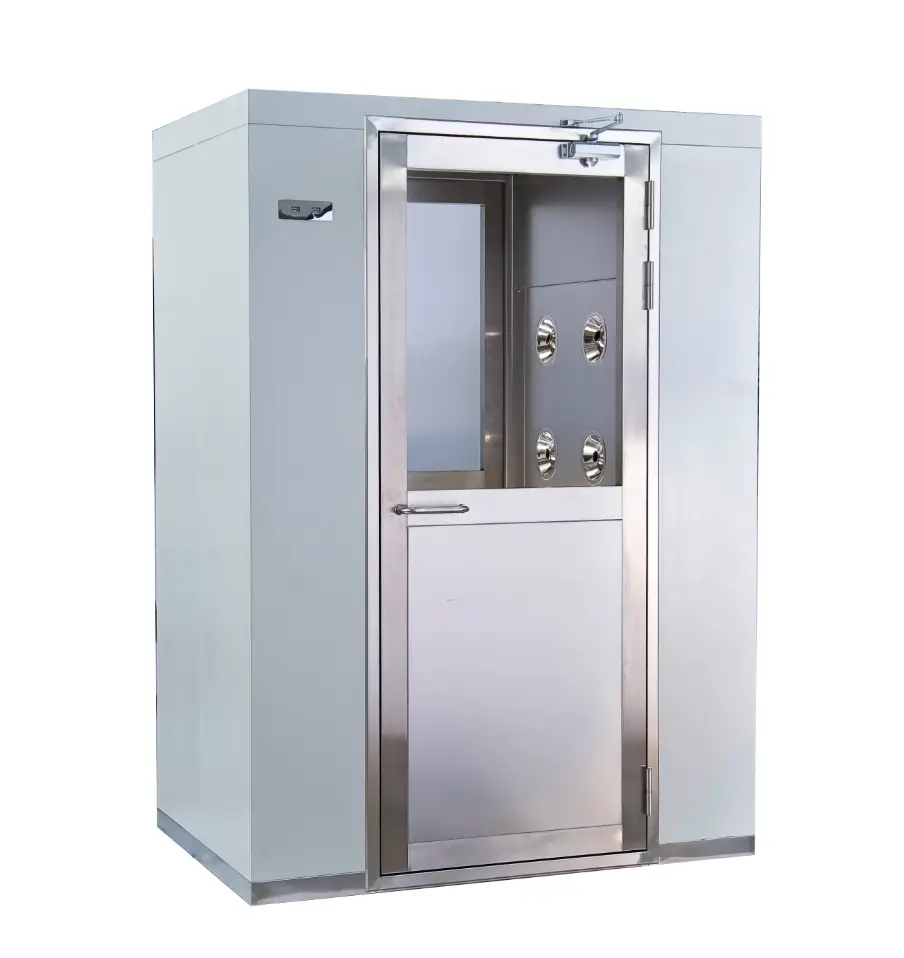
An air shower is an enclosed passageway located at the entrance to a clean room or other controlled environment. High-velocity, filtered air is directed through strategically positioned nozzles towards personnel, their garments, and sometimes materials entering the controlled area. This dislodges loose particles from exposed surfaces, while the airflow and filtration system in the chamber helps to capture or remove particles, rather than allowing them to pass directly into the cleanroom. Most personnel air showers also have interlocking doors to prevent both doors from opening simultaneously, which supports the pressure and contamination control strategy at the entry point.
The principle is straightforward: people are a significant source of particles in cleanrooms because clothing, skin, hair, and movement release particulate matter. Even when workers wear cleanroom garments, particles may accumulate on the fabric or be released as the person moves. An air shower uses turbulent, directed airflow to detach some of these particles before entry. The effectiveness of this process depends on whether the air jets reach the relevant surfaces, whether particles are removed from the chamber effectively, and whether the operating procedure allows enough time for it to work.
However, an air shower is not a substitute for proper gowning, cleanroom-compatible garments, hand hygiene, or controlled movement of personnel. It does not sterilise people, eliminate microorganisms reliably from all surfaces, or guarantee that every particle has been removed. Its role is more limited: it provides an additional mechanical particle-removal step within a broader contamination-control system.
How Effective Are Air Showers at Removing Particles?
In short, air showers can remove a significant proportion of particles, but there is no single efficiency figure that applies to every installation. A 1996 article by T. M. Loughran and M. J. Shea, which is often cited, summarised test results showing removal efficiencies of approximately 35–90%, depending on factors such as particle size, air-shower design, garment type, gowning procedures, user behaviour, cycle time and cleanroom classification. This wide range is significant because an air shower’s performance depends on the entire system and its operating conditions, not just the presence of a high-speed fan.
Other research demonstrates why test methods matter. A chapter on cleanroom principles, available via PubMed Central, discusses experiments in which particle removal differed according to body location, nozzle arrangement, airflow velocity, and whether the garment or test subject was moving. One set of reported measurements showed that removal from the chest was higher than from the feet, demonstrating that an effective overall result can mask less effective cleaning at specific locations. The same discussion notes that air showers can temporarily increase the concentration of particles inside the chamber because dislodged particles become airborne before being extracted or deposited.
A separate study by William Whyte and D. McGeorge, published in Microcontamination in 1994, concluded that the tested air shower was ineffective in reducing particle dispersion from cleanroom personnel. This does not prove that all air showers are ineffective, but rather highlights the difference between removing particles from garment surfaces under controlled conditions and demonstrating a meaningful reduction in contamination reaching the cleanroom. For facility managers, this distinction is crucial: a manufacturer’s particle-removal percentage should not be taken as evidence of a corresponding reduction in contamination inside the production area.
What Factors Determine Air Shower Performance?
Several engineering and operational factors determine whether an air shower delivers measurable benefits. Evaluating these variables together is more useful than comparing systems on a single advertised efficiency number.
- Air velocity and nozzle coverage. Air jets need enough momentum to dislodge particles from garments, but nozzle placement matters as much as nominal velocity. Poorly directed jets may leave areas such as the back, lower legs, cuffs, and spaces beneath the arms inadequately exposed. Nozzle design, airflow distribution, and the distance between the nozzles and the user should therefore be considered during equipment selection and performance testing.
- Cycle time and user movement. A short cycle may fail to expose all garment surfaces to the air jets, while a longer cycle does not necessarily deliver proportionally greater particle removal. The 1996 research summarized by Loughran and Shea identifies cycle time and shower-use technique as important variables, and other published testing has reported that movement and garment vibration can influence removal results. Personnel should follow the validated procedure, including any required turning or arm movements, rather than assuming that standing still in the chamber is sufficient.
- Garment type and condition. Particle adhesion varies with fabric construction, surface texture, electrostatic behavior, and the condition of the garment. Cleanroom clothing that is properly laundered and stored provides a different starting point from a garment that is heavily contaminated, damaged, or worn outside controlled areas. Air showers should not be expected to compensate for incorrect gowning or unsuitable clothing.
- Filtration and particle extraction. High-efficiency filtration helps supply clean air to the nozzles, but removing particles from clothing is only half of the process. The chamber must also manage the particles dislodged into the air so that they are not simply carried toward the cleanroom entrance or redeposited on garments. The return-air arrangement, filter condition, airflow pattern, and door sequence all affect the overall result.
- Maintenance and validation. Clogged nozzles, damaged door seals, worn interlocks, reduced airflow, or loaded filters can change performance over time. A chamber that worked well during commissioning may not maintain the same results if maintenance and performance checks are neglected. The appropriate inspection and requalification schedule should be established from the equipment design, risk assessment, and facility quality system.
Where Are Air Showers Most Useful?
Air showers are most useful in environments where personnel movement creates a significant and manageable route for particulate contamination to enter a controlled area. They are commonly used in the manufacture of semiconductors and electronics, pharmaceuticals, medical devices, precision optics, and in the assembly of aerospace components, as well as in other environments in which airborne particles can affect product quality or process reliability. While the ISO 14644 series provides a framework for cleanroom classification and the assessment of equipment in controlled environments, the suitability of a specific air shower must be evaluated in relation to the facility in question and its contamination control objectives.
Their effectiveness depends on the entry system around them. For instance, while a well-designed air shower can help control particles at the entrance of a semiconductor production area for personnel, it cannot compensate for poor gowning, uncontrolled traffic, inadequate cleanroom filtration, or improper material transfer practices. In pharmaceutical environments, a facility’s contamination control strategy may require additional controls for microbial contamination, cleaning, disinfection, and process-specific risks. Air showers primarily address removable particulate contamination and should not be treated as sterilisation devices or a substitute for validated microbiological controls.
The same distinction applies when air showers are used for material transfer. A chamber designed for people may not provide the necessary space, airflow coverage, loading arrangements or cleaning access for carts, containers and equipment. Where materials are the primary source of contamination, a dedicated air shower for materials or another validated transfer solution may be more appropriate. The correct design should follow the risk assessment rather than assuming that one chamber configuration suits all applications.
Air Showers vs. Other Cleanroom Entry Controls
An air shower is only one element in a cleanroom entry strategy. Depending on the facility, alternatives or complementary controls may include gowning rooms, sticky mats, controlled material-transfer procedures, airlocks, and validated cleaning processes. These measures address different contamination pathways, so they should not be compared as if they all perform the same function.
| Control method | Primary purpose | Main advantage | Important limitation |
| Personnel air shower | Dislodges loose particles from garments using directed filtered air | Can reduce surface particulate contamination before entry | Performance varies; it does not guarantee that particles will not enter the cleanroom |
| Gowning room and garment protocol | Controls clothing and personnel preparation | Establishes consistent cleanroom entry behavior | Depends on correct procedures and personnel compliance |
| Sticky mats | Captures some particles from footwear and wheels | Simple additional control near entrances | Does not clean the upper body or remove all contamination from shoes |
| HEPA-filtered cleanroom ventilation | Controls airborne particle concentrations in the room | Provides ongoing airborne contamination control | Does not directly remove all particles attached to personnel or materials |
| Material-transfer cleaning | Removes contamination from packaging, carts, and incoming equipment | Targets contamination introduced by transferred objects | Requires suitable cleaning methods and validated procedures |
The comparison shows why the effectiveness of an air shower should be judged by its contribution to the complete entry process. A facility with strong gowning procedures and appropriate ventilation may achieve good contamination control without relying heavily on air showers, while another facility may benefit from adding one to address a specific risk. The appropriate decision depends on the cleanroom’s required cleanliness level, process sensitivity, traffic patterns, and evidence from performance testing.
How to Verify Whether an Air Shower Is Effective?
The most reliable way to assess an air shower’s performance is to test it under defined conditions, rather than relying on brochure claims or airflow specifications alone. A useful validation plan should establish a baseline, define the particle sizes of interest, standardise the garment and user procedure, and measure the results before and after the shower cycle. The test should also reflect the facility’s actual operating conditions as closely as possible. The International Confederation of Contamination Control Societies has published work examining the required performance of air showers and how their effectiveness should be evaluated.
A practical assessment typically includes four elements:
- Particle-removal testing: Measure particle levels on or around representative garments before and after the shower cycle, using a consistent sampling method. Record particle sizes separately because performance can differ substantially across size ranges.
- Airflow verification: Check nozzle velocity and distribution at representative positions. An acceptable average can conceal weak airflow from individual nozzles, so the measurement plan should examine coverage rather than relying on one reading.
- Operational checks: Verify cycle timing, door interlocks, air circulation, filter condition, and other features specified by the manufacturer. Confirm that the chamber operates as intended under normal use.
- Cleanroom impact assessment: Where justified by contamination risk, measure particles in the cleanroom during a controlled comparison of entry conditions with and without the air shower. This helps establish whether surface particle removal translates into a meaningful reduction in contamination entering the facility.
ISO 14644-14 provides a methodology for assessing the suitability of equipment for use in cleanrooms with respect to airborne particle concentration, while the broader ISO 14644 framework addresses cleanroom and controlled-environment performance. These standards provide useful context for contamination-control assessments, but they do not establish one universal particle-removal percentage that every air shower must achieve. Acceptance criteria should be defined for the specific application and documented in the facility’s quality and validation system.
Common Mistakes When Evaluating Air Showers
A common mistake is to treat a manufacturer’s particle-removal efficiency as a guarantee of cleanroom performance. A result obtained from testing a garment under controlled conditions may not accurately predict the level of contamination in a production room, particularly if different movements, garments, or cycle times are used by personnel. Always examine the test method, particle-size range, sampling location, and operating conditions behind a performance claim before comparing suppliers.
Another mistake is assuming that longer cycles automatically provide better results. While additional exposure can be helpful in some cases, effectiveness can plateau, and dislodged particles still need to be removed from the chamber. Similarly, increasing airflow without considering nozzle coverage, garment response, noise, and the air-return design of the system may not improve overall contamination control. Equipment should be selected and commissioned based on measurable requirements rather than simply the highest advertised velocity.
Finally, an air shower should not be used to compensate for weaknesses elsewhere in the contamination control programme. Poor gowning discipline, dirty incoming materials, inadequate filtration, incorrect room pressure relationships and insufficient maintenance can all undermine its effectiveness. A well-managed facility treats the air shower as one engineered barrier within a documented strategy with clear operating procedures, maintenance responsibilities and performance criteria.
Frequently Asked Questions About Air Showers
- Are air showers effective in cleanrooms?
Yes, air showers can remove loose particles from cleanroom garments, but effectiveness varies with equipment design, garment type, particle size, and user behavior. Their real value should be verified through testing under representative operating conditions.
- What is the particle removal efficiency of an air shower?
Published results summarized by Loughran and Shea report approximately 35%–90% removal under different test conditions. This range is not a guaranteed specification for every air shower or proof of an equivalent reduction in cleanroom contamination.
- How long should a person stay in an air shower?
The cycle time should follow the equipment manufacturer’s instructions and the facility’s validated operating procedure. A longer cycle is not automatically more effective, so the selected duration should be supported by performance testing.
- Do air showers remove bacteria and viruses?
Air showers can dislodge some particles that may carry microorganisms, but they are not sterilization or disinfection devices. They should not replace validated hygiene, garment-handling, cleaning, or microbiological controls where those are required.
- Are air showers required for every ISO-classified cleanroom?
No universal rule requires every ISO-classified cleanroom to use an air shower. The decision depends on the contamination-control strategy, process risks, personnel-entry design, and applicable regulatory or customer requirements.
- How can you tell whether an air shower is working properly?
Check airflow and nozzle performance, confirm that filters and interlocks operate correctly, and conduct particle-removal testing using a consistent procedure. Where necessary, measure particle levels in the cleanroom to determine whether the air shower reduces contamination under real operating conditions.
Conclusion
Although air showers can be effective at removing loose particles from personnel and garments before entering a cleanroom, their performance is variable rather than guaranteed. Published research reports a wide variety of results regarding particle removal and emphasises the distinction between cleaning a garment’s surface and reducing contamination that ultimately enters the controlled environment.
The best approach for facility managers and cleanroom engineers is to select an air shower based on contamination risk, verify airflow and particle removal performance, maintain the equipment, and integrate it with gowning, filtration, and material transfer procedures. An air shower is most valuable when its contribution to contamination control is demonstrated through repeatable testing, rather than simply being assumed from its presence.


