
Article Summary: A clean pass box is an enclosed, double-door transfer chamber installed between cleanrooms or areas with different cleanliness requirements. It allows materials, tools, and samples to be moved between environments without the need to repeatedly open the main room doors or create a direct connection between them. As discussed in the International Society for Pharmaceutical Engineering (ISPE) article ‘Pass-Through Boxes in Life Sciences Cleanrooms’, interlocking doors and a cleanable construction help to reduce the risk of contamination during material transfer.
The ISO 14644 series provides a broader framework for classifying and controlling cleanroom cleanliness. While a clean pass box supports contamination control, its effectiveness depends on the selection of appropriate equipment, the implementation of validated procedures where required, and integration with the facility’s overall cleanroom design.
What Is a Clean Pass Box?
A clean pass box, also known as a cleanroom pass box, pass-through box, or transfer hatch, is a compact, enclosed chamber built into a partition between two areas. It enables operators to transfer items such as packaging components, laboratory samples, production tools, raw materials, and small equipment between areas without carrying them through a personnel doorway. Most designs have one door on each side with an interlocking mechanism that prevents both doors from opening simultaneously. This creates a controlled transfer point and helps to preserve the separation between adjacent environments.
The purpose of the equipment goes beyond simply providing a convenient opening in a wall. Every time a cleanroom door opens, air movement, personnel activity, and material handling can affect the room’s contamination control conditions. A properly selected clean pass box reduces the need for routine personnel movement and provides a defined process for material transfers. Depending on the application, it may provide passive separation alone, or it may incorporate HEPA-filtered airflow, timed interlocks, or other decontamination features.
However, a clean pass box does not independently make an item sterile or guarantee a particular cleanroom classification. Rather, it is one component of a broader contamination-control strategy that may also include HVAC design, pressure differentials, gowning, cleaning, disinfection, material packaging, and operating procedures.
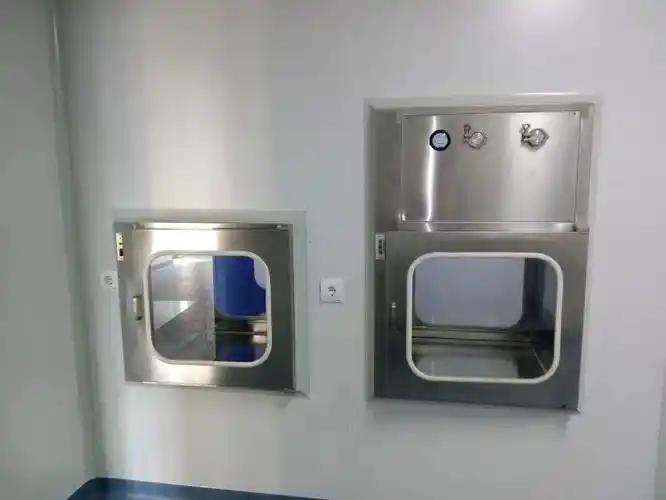
What Is the Main Purpose of a Clean Pass Box?
The primary purpose of a clean pass box is to transfer materials between controlled areas while minimizing the contamination risks associated with open doors, unnecessary personnel movement, and uncontrolled air exchange. Its practical value comes from several connected functions.
- Reducing Cross-Contamination Risks
Cross-contamination can occur when particles, microorganisms, residues, or other unwanted substances move from one area to another through people, equipment, packaging, or air. A pass box establishes a physical barrier between the two sides and prevents them from being connected by simultaneously open doors. This is especially useful when a production process requires materials to enter a cleaner area from a corridor, warehouse, preparation room, or lower-grade production zone.
The degree of protection depends on the equipment configuration and the materials being transferred. A basic static pass box provides isolation, while a dynamic model uses filtered airflow to help remove airborne particles from the chamber. Where microbiological contamination is a concern, a separate, properly validated decontamination process may be necessary; a standard interlock or optional UV lamp should not automatically be treated as proof of sterilization.
- Maintaining Cleanroom Environmental Conditions
Cleanrooms are designed to control airborne particles and, depending on the process, other contamination variables. Frequent opening of main doors can disturb airflow patterns and pressure relationships, particularly when staff move repeatedly between rooms. A clean pass box gives materials a dedicated transfer route and can reduce the number of times personnel doors need to be opened for routine deliveries.
This benefit is most meaningful when the pass box is incorporated into the facility’s pressure cascade and material-flow design. Its seals, installation, door interlocks, and operating sequence must be compatible with the cleanroom’s environmental controls. A pass box is not a substitute for suitable ventilation or pressure management; rather, it helps the wider system operate with fewer avoidable disturbances.
- Improving Workflow and Personnel Efficiency
In pharmaceutical production, electronics manufacturing, laboratories, and other controlled environments, small items may need to cross a room boundary many times during a shift. Requiring an operator to leave one area, follow gowning or entry procedures, and enter another area for each transfer can consume time and increase traffic through personnel airlocks. A pass box allows designated operators on either side to transfer materials through a repeatable procedure.
The result can be a more organized production layout, fewer unnecessary room entries, and a clearer separation between personnel movement and material movement. For high-frequency transfers, the chamber size, shelf layout, door-opening method, and cycle time should be chosen around the actual workflow rather than selected on purchase price alone.
How Does a Clean Pass Box Work?
A clean pass box involves a controlled loading and unloading sequence. In a typical installation, the operator opens the accessible door on the sending side, places the material inside, and closes the door fully. The interlock then secures the door while allowing access from the receiving side according to the control logic of the equipment. For models with an air-cleaning or decontamination cycle, this must finish before the receiving door can be released. Once the item has been removed, both doors must be closed again to restore the isolated condition of the chamber.
The standard transfer procedure should be documented in the facility’s operating procedures and adjusted according to the cleanliness risk of the application. A practical sequence includes the following steps:
- Prepare the material. Confirm that the item is approved for entry, suitably packaged where necessary, and free of visible dirt or damaged outer packaging.
- Load from the authorized side. Open only the permitted door and place the item so that it does not obstruct the door, seals, or any airflow openings.
- Close and secure the first door. Check that it has latched correctly; do not attempt to defeat the interlock to speed up the transfer.
- Complete any required treatment. Allow the specified airflow purge, timed holding period, or validated decontamination cycle to finish where the model and procedure require it.
- Retrieve the material. The receiving-side operator opens the opposite door only when the system permits access, removes the item, and closes the door after use.
The exact sequence depends on the design. A static unit may have no active air-treatment cycle, while a dynamic or decontamination-equipped model requires additional steps. In all cases, staff should follow the manufacturer’s instructions and the facility’s approved procedures instead of assuming that every pass box works identically.
What Are the Different Types of Clean Pass Boxes?
Clean pass boxes differ mainly in how they control the transfer environment. The correct choice depends on the cleanliness difference between the two areas, the sensitivity of the material, transfer frequency, and whether particle removal or microbial decontamination is required.
| Type of clean pass box | Main function | Typical applications | Key consideration |
| Static pass box | Provides physical separation and interlocked access without active air filtration | General clean areas, packaging rooms, and transfers between compatible environments | Suitable when passive isolation meets the risk assessment |
| Dynamic pass box | Uses a fan and HEPA filtration to reduce airborne particles inside the chamber | Electronics, precision assembly, and selected pharmaceutical processes | Airflow design, filter integrity, and maintenance need attention |
| Air-shower pass box | Directs high-velocity filtered air over item surfaces to dislodge particles | Components or packaging with a greater surface-particle burden | Air showering does not automatically remove all contaminants or sterilize items |
| Decontamination pass-through | Incorporates a specified decontamination process, such as a validated vapor-phase cycle | Applications with defined microbiological or aseptic transfer requirements | Process compatibility, cycle validation, and safety controls are essential |
The terms used by manufacturers are not always identical, and product labels alone do not establish performance. For example, a pass box marketed as “self-cleaning” may provide filtered airflow, an air shower, or a more specialized process. Buyers should confirm the actual operating principle, filtration specifications, available cycle controls, and documented performance rather than relying on the model name.
Where Are Clean Pass Boxes Used?
Clean pass boxes are useful wherever materials need to cross a controlled boundary without creating an unnecessary route for contamination. Their requirements vary by industry because the risks associated with particles, microorganisms, chemical residues, and static electricity are different.
- Pharmaceutical and biotechnology facilities: They transfer components, containers, tools, and production supplies between preparation areas and controlled manufacturing zones. Where aseptic processing is involved, the pass box and transfer procedure must fit the facility’s contamination-control strategy and applicable validation requirements.
- Hospitals and laboratories: They can support the movement of instruments, specimens, supplies, or other approved items between designated areas. The chamber’s suitability depends on the specific biological risks, cleaning protocol, and institutional procedures.
- Semiconductor and electronics manufacturing: Small particles can affect sensitive components and manufacturing yields. Dynamic units or other engineered configurations may be considered when passive separation alone does not meet the process requirements.
- Food, cosmetics, and medical-device production: Pass boxes can help organize ingredient, packaging, tooling, and component transfers between rooms with different hygiene or cleanliness requirements. Materials and surfaces should be compatible with the cleaning agents and sanitation practices used on site.
These applications share the need for controlled material movement, but they do not share one universal specification. A pass box appropriate for packaging materials in a general clean area may be unsuitable for transferring items into a critical aseptic zone. The required performance should be defined by the process and risk assessment, not inferred from the industry name alone.
How to Choose the Right Clean Pass Box?
Selecting a clean pass box starts with the transfer route rather than the equipment catalogue. Before requesting a quotation, define the room conditions on both sides, what will pass through the chamber, how frequently transfers occur, and what treatment—if any—the material requires.
- Define the Cleanliness and Contamination-Control Requirements
Identify the cleanliness classification of each connected area and determine whether the transfer involves ordinary particles, sensitive components, biological hazards, or aseptic materials. The ISO 14644 series provides a framework for cleanroom classification and related contamination-control considerations, but the presence of an ISO class does not by itself determine the correct pass box. The design must account for the complete installation and intended use.
- Select the Appropriate Construction and Features
Stainless steel is commonly used because it is durable and can be cleaned effectively when properly designed. Grade 304 stainless steel may suit many general applications, while grade 316 may be preferable in environments with more demanding corrosion or chemical-exposure requirements. Smooth internal surfaces, accessible corners, suitable seals, and compatible hardware can make routine cleaning more reliable.
The interlock is another critical selection point. A mechanical interlock may be appropriate for straightforward applications, while an electronic interlock can support indicators, timed sequences, or integration with other controls. Optional HEPA filtration, air showering, viewing windows, UV lamps, or automated doors should be specified only when they serve a defined operational need.
- Confirm Dimensions, Installation, and Maintenance Access
Measure the largest item to be transferred, including its packaging and any handling tray. The chamber should provide sufficient clearance for loading and retrieval without forcing operators to tilt or drag items across surfaces. Confirm wall thickness, installation orientation, electrical requirements, door swing or sliding clearance, and access for filter replacement or servicing before finalizing the design.
| Selection factor | Questions to confirm with the supplier | Why it matters |
| Transfer requirements | What are the dimensions, weight, packaging, and frequency of transferred items? | Prevents handling problems and delays |
| Cleanliness boundary | What are the requirements on both sides of the wall? | Helps determine whether a static or active-airflow design is appropriate |
| Construction | Which materials, finishes, seals, and cleaning agents are compatible? | Supports durability and effective cleaning |
| Door interlock | Is the mechanism mechanical or electronic, and how is failure handled? | Protects the separation between the two areas |
| Air treatment | Is HEPA filtration, air showering, or a validated decontamination cycle needed? | Matches the equipment to the actual contamination risk |
| Installation and service | What utilities, clearances, filter access, testing, and maintenance are required? | Reduces installation problems and lifecycle costs |
For projects involving regulated production, also confirm the documentation package: drawings, operating and maintenance instructions, relevant test records, and any qualification or validation support required by the project. A supplier’s general statement that a unit is “cleanroom compatible” should not replace project-specific evidence.
Operating and Maintaining a Clean Pass Box
Even a well-designed clean pass box can pose a contamination risk if staff bypass the interlock, load unsuitable materials or neglect cleaning and inspection procedures. A routine maintenance programme should address the physical condition of the chamber and the performance of any active systems. Before use, operators should inspect the door seals, hinges, latches and interlock, and report any failure that could allow both doors to open or prevent the chamber from closing properly.
Cleaning procedures should specify approved cleaning agents and materials, cleaning frequency, and who is responsible for cleaning. Internal surfaces should be cleaned according to the facility’s procedure, particularly after spills, damaged packaging, or transfers that may leave residues. For dynamic models, maintenance should also cover fan operation, filter condition, airflow performance, and any differential pressure or alarm indicators provided by the design. Filter replacement intervals should be based on the manufacturer’s recommendations and actual monitoring results rather than a universal calendar schedule.
Where UV lamps or other decontamination features are installed, staff must understand their limitations and operating requirements. The effectiveness of UV depends on factors such as exposure time, intensity, shadowing, and the susceptibility of the target organism. The presence of a lamp alone does not demonstrate that a transfer has been disinfected. For critical applications, the process must be supported by suitable evidence and validated procedures.
As cleanroom equipment suppliers, at UPTING we focus on matching clean pass box configurations to the intended transfer process. Options include 304/316 stainless steel construction, mechanical or electronic interlocks, and HEPA-filtered airflow. We recommend confirming room conditions, material dimensions, cleaning requirements, and required performance documentation before selecting a model, rather than assuming that one configuration will suit every cleanroom.
Common Mistakes to Avoid
Several avoidable mistakes can undermine the benefits of a clean pass box. First, choosing a static unit when the process requires active particle control may leave a gap in the contamination-control strategy. Second, treating a UV lamp or an air shower as a universal sterilization solution can create false confidence, particularly where microbial control is critical. Third, overlooking seal compatibility, maintenance access, or the interlock’s failure behavior can lead to operational problems after installation.
A further mistake is to assume that the pass box alone guarantees compliance with ISO cleanroom classifications or pharmaceutical requirements. Cleanroom performance depends on the complete facility, including ventilation, pressure relationships, personnel practices, cleaning, and material handling. The equipment should therefore be specified, installed, operated, and maintained as part of a documented system.
Clean Pass Box FAQs
- What is the main purpose of a clean pass box?
The main purpose of a clean pass box is to transfer materials between cleanrooms or controlled areas while reducing contamination risks caused by unnecessary door openings and direct air exchange. Its interlocked doors create a controlled transfer point without requiring personnel to move between rooms for every item.
- What is the difference between a static and a dynamic pass box?
A static pass box provides physical separation through an enclosed chamber and interlocked doors but does not actively filter the chamber air. A dynamic pass box adds a fan and filtration system to help reduce airborne particles, making it suitable for applications that require additional particle control.
- Does a clean pass box sterilize materials?
No, a standard clean pass box does not sterilize materials simply by transferring them through the chamber. Sterilization or decontamination requires a suitable process with appropriate validation, and optional UV lighting should not be assumed to guarantee sterility.
- Where should a clean pass box be installed?
A clean pass box is generally installed in a partition between areas that need controlled material transfer, such as a cleanroom and a preparation room or two rooms with different cleanliness requirements. The installation location should be determined by the facility’s material flow, pressure relationships, and contamination-control strategy.
- What materials are clean pass boxes made from?
Many clean pass boxes use 304 stainless steel because it is durable and easy to clean when properly finished. Grade 316 stainless steel may be preferred where greater corrosion resistance is needed, but the appropriate material depends on the cleaning chemicals and operating environment.
- How do you choose the right clean pass box?
Choose a clean pass box based on the cleanliness requirements on both sides, the type and size of items transferred, the frequency of use, and whether active filtration or decontamination is required. Before ordering, confirm interlock behavior, construction materials, installation dimensions, maintenance access, and any testing or documentation required for the application.
Conclusion
A clean pass box is an essential component of cleanroom contamination control, as it separates material transfer from routine personnel movement, thereby limiting direct connections between controlled areas. Its effectiveness depends on more than just the enclosure itself; door interlocking, construction methods, operating procedures, maintenance, and, where necessary, validated air treatment or decontamination processes all influence its performance. By defining the transfer risk before selecting equipment, facility managers can select a configuration that supports cleanroom integrity and efficient daily operations.


